
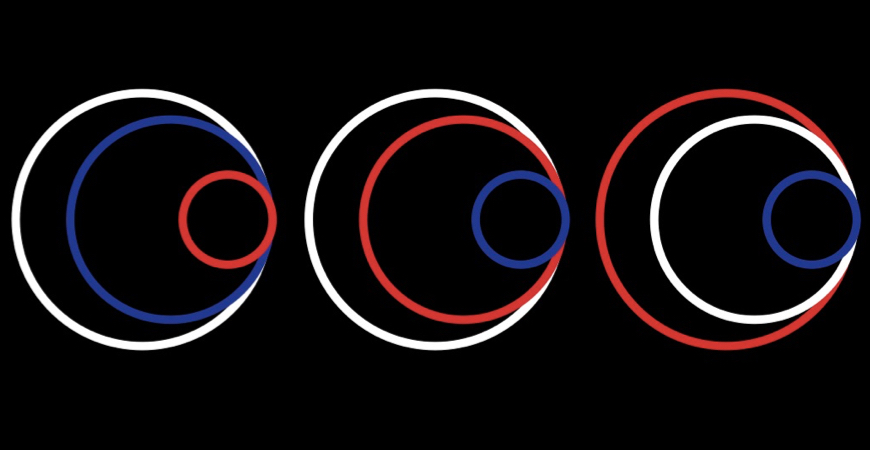
If you were intruiged by the hit Netflix series "3 Body Problem" and its exploration of the implications of chaotic interstellar dynamics, a new study by MCS PhD candidate Andrea Montaño Ramirez adopts the same theoretical perspective to analyz the rise of China and the Global South in the global science ecosystem, showing that the emergence of these two additional scientific "bodies" (i.e., regional cores) has disrupted the once-stable Anglophone dominance in global science, transforming it into an unpredictable multi-polar system characterized by dynamical instability. Read the abstacts below and follow the link to read the full article!
1) Montaño Ramirez, A. & Petersen, A. M. (2026). Transformation of Global Science core–periphery structure towards a multi-polar horizon: The Rise of China and the Global South from 1980–2020. Research Policy 55, 105370.
Abstract: The global post-industrial shift has witnessed vast geo-political and technological transformations — but to what degree are they mirrored in the scientific enterprise? We examine the structure and dynamics of international collaboration networks from 1980 to 2020, which features the disruptive shift from the longstanding Anglophone duopoly to the multi-polar landscape of the 21st century. To this end, we develop a systematic framework for tracking core–periphery dynamics, which facilitates analyzing the structural factors underlying the ascendance of China and other global south nations. To provide a more granular perspective on the shifting geo-political role of the United States (US) within the global science system, we disaggregated cross-border publications by US states alongside other countries. Longitudinal analysis illustrates the global shift from Euro-American dominance to a multipolar system, with China emerging as a leader and facilitating the integration of its most active partners into the rich club of scientific production. This structural transformation has, nevertheless, altered the stability of longstanding systemic hierarchies and is reminiscent of the “Three-Body Problem” in dynamical systems theory, where the addition of massive poles reduces the system’s stability and predictability. Our findings also highlight the roles of overarching national (US) and transnational (European Union) innovation systems, and the expansive influence of large team science projects as two factors promoting global science integration. These insights provide a fresh perspective on the analysis of global science and its implications for national science policy development, offering strategies for global science countries to strengthen their positions in an increasingly integrated global science system.
What is the 3-body problem? To summarize the relevant principles of the ‘‘three-body problem’’, consider a canonical physical system where two celestial bodies interact gravitationally (e.g., Earth orbiting the sun) such that their past and future positions can be predicted with high precision. This follows because the gravitational equations of motion are deterministically solvable, and so the system behaves in a way we can fully understand – and predict – in particular because the center of mass offers a valuable reference frame for solving the system exactly. However, as aptly explained by TED-Ed (2020), when a third body of substantial mass enters the system, its evolution becomes sensitive to initial conditions, such that tiny differences in relative positions can lead to dramatically different future configurations. This is the essence of the ‘n-body’ problem: there is no exact formula to predict the future position of all bodies, and attempts to numerically approximate future trajectories are susceptible to cumulative predictive errors that grow with the prediction horizon. Moreover, this property of correlated nonlinear dynamical systems does not rely on the equations of motion being gravitation-based, and generalizes to other non-linear forcing functions. Here, we adopt this perspective as it provides a relevant metaphor for understanding the evolution of the global science system. For much of the 20th century, the system was essentially a two-body model: the US and Europe dominated, setting the pace and direction of global scientific collaboration. As such, interactions were relatively predictable, and the system was relatively stable. But with the rise of new scientific poles – in particular China, and also Latin America – the system has entered the n- body regime. Consequently, scientific influence is no longer concentrated in two predictable centers of mass, but rather, is subject to sensitive interdepen- dency. As in the gravitational scenario, a multipolar system structure is more difficult to understand in simple terms and to forecast. Nevertheless, a lack of predictability may foster more diverse, decentralized, and dynamic systems of global knowledge production.
Highlights
- Analyzed evolution of global science across nations and U.S. states from 1980-2020.
- Core-periphery dynamics show emerging multi-polarity featuring China and Global South.
- Global integration yields power shifts instability, analogous to “Three-Body Problem”.
- Innovation systems shape the structure and dynamics of global science integration.
- Varied global integration pathways show that big science moderates national ascension.


